


Region
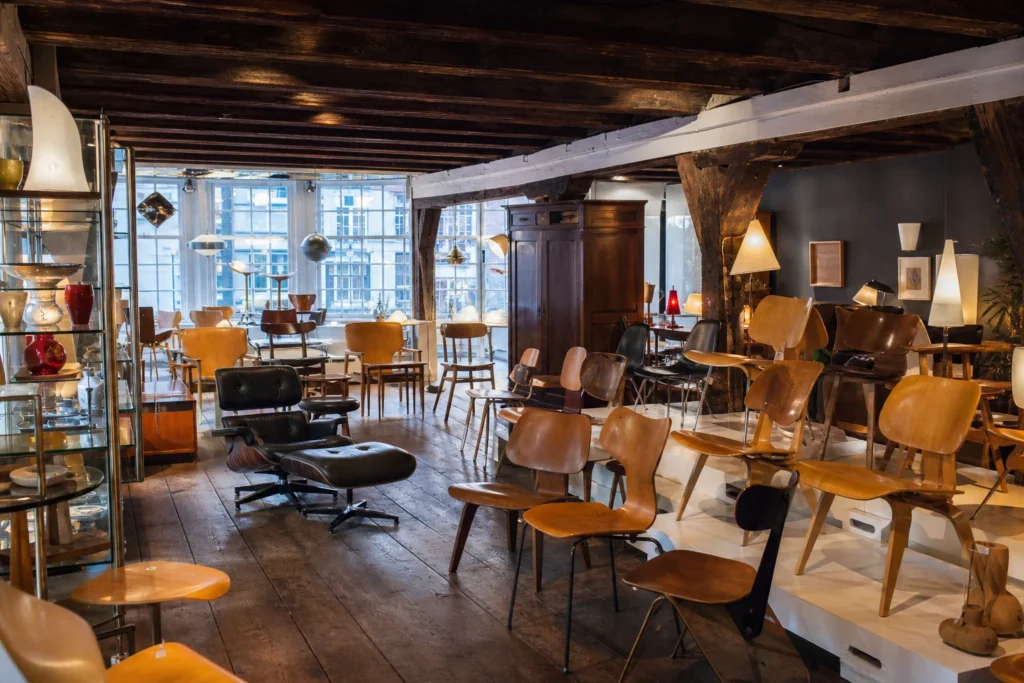
The ceiling stops you first. It dates to 1565, and the dark timber beams stretch above a floor stacked with plywood chairs unlike anything else in Amsterdam. WonderWood occupies a building near Dam Square on Rusland 3, and the contrast between the centuries-old shell and its mid-century contents is entirely deliberate.
Founder Wiet Hekking came to design through three decades in the international fashion industry. His travels sharpened an eye for materials and form, and he became absorbed by the 3D plywood techniques developed in the 1950s. That obsession built into a collection of rare vintage chairs and, eventually, into this shop.
The specialist focus runs from the 1930s to the 1970s, and the floor holds more than 100 vintage plywood chairs at any time. Rare originals from the 1940s, 1950s and 1960s sit alongside re-editions of canonical pieces — work by Charles and Ray Eames, Alvar Aalto, Jean Prouvé and Norwegian designer Hans Brattrud. These are not decorative props. Each piece carries a documented history, available in-store and through the shop's online content.
Prices span the full range of seriousness. A beautifully made wooden pencil can leave with you for €1. Museum-quality acquisitions occupy the other end of the scale. Somewhere between those two points, most visitors find something worth pausing over. Contemporary Dutch designers including Richard Hutten, Aldo Bakker and Jeroen Wand contribute new work, and the gallery wall features artists such as Jeroen Henneman, Klaas Gubbels, Willem van Malsen, Wietze Jellema and Ton van Kints. The result is a space that operates as both a serious design gallery and an accessible shop.
When Hekking is not occupied in his back office, he often talks with visitors about the pieces on show. His knowledge of plywood design history is genuine and detailed, and those conversations can turn a quick browse into something longer.
WonderWood opens Wednesday through Saturday from noon to 6pm, and stays closed on Sunday, Monday and Tuesday. Design-aware travellers and collectors tend to treat it as a fixed point on any Amsterdam itinerary.
The shop sits at Rusland 3, close to the centre. Rokin tram stop is approximately 250 m away, served by tram lines 4 and 14. Nieuwmarkt metro station — lines 51, 53 and 54 — is around 350 m in the opposite direction. Amsterdam Centraal, the main rail hub, is roughly 1 km away and connects the area to the rest of the city and beyond.
Frequently Asked Questions
Q: What is WonderWood's specialist focus, and is it worth visiting if you are not a serious collector?
A: WonderWood concentrates on plywood furniture and design from the 1930s to the 1970s, with more than 100 vintage chairs on the floor at any time. The price range runs from a €1 wooden pencil up to museum-quality acquisitions, so there is genuinely something for casual browsers and serious collectors alike. The building itself — with a ceiling dating to 1565 — is worth the detour on its own terms.
Q: What kinds of pieces can I expect to find?
A: The collection mixes rare vintage originals from the 1940s, 1950s and 1960s with re-editions of canonical pieces by designers including Charles and Ray Eames, Alvar Aalto, Jean Prouvé and Hans Brattrud. Contemporary Dutch designers such as Richard Hutten and Aldo Bakker contribute new work, and the gallery wall features paintings and prints by several Dutch artists. Each piece carries a documented history, available in-store and through the shop's online content.
Q: When is WonderWood open?
A: The shop opens Wednesday through Saturday, noon to 6pm, and is closed Sunday, Monday and Tuesday. Check the shop's official channels before you visit to confirm current hours, as these can change.
Q: How do I get there from central Amsterdam?
A: WonderWood is at Rusland 3, close to Dam Square. The Rokin tram stop (lines 4 and 14) is around 250 m away, Nieuwmarkt metro station (lines 51, 53 and 54) is around 350 m in the opposite direction, and Amsterdam Centraal is roughly 1 km away.
Q: Is the founder usually present, and can I ask questions about specific pieces?
A: Founder Wiet Hekking is often in the shop and, when not occupied in his back office, is known to talk in depth with visitors about plywood design history and individual pieces. His background spans three decades in international fashion before a sustained focus on mid-century plywood technique, so those conversations tend to be detailed and worth seeking out.
Marketplace Highlights








Add a review