

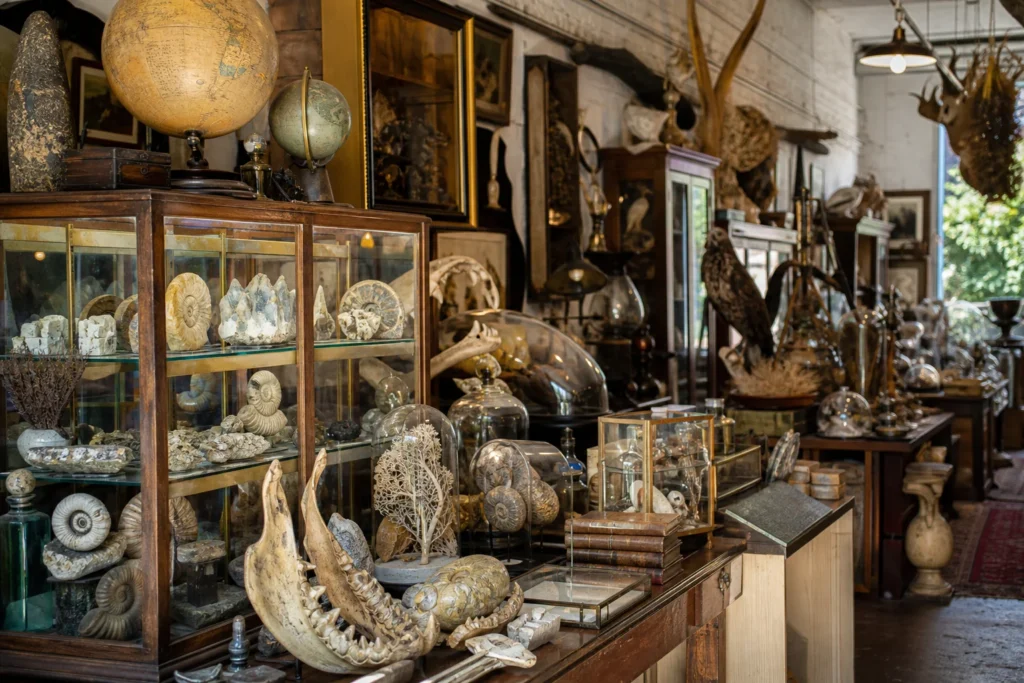
Ray Meyer named his Melbourne shop after the German tradition of the Wunderkammer — the cabinet of curiosities — and the store at 439 Lonsdale Street lives up to that heritage. It is one of the more singular retail spaces in the city. You know within a few steps that you are somewhere unusual.
The natural history and geological material forms one strong current through the collection. Fossils, dinosaur teeth and meteorites share space with rare minerals and gemstones. Each piece arrives because it satisfies Meyer's curatorial standard: visual appeal, historical weight or genuine scientific interest. Nothing feels like filler.
A second cluster draws collectors of early scientific and navigational material. Antique maps and globes sit alongside scientific instruments, anatomical models and botanical prints. The range spans cartography to palaeontology, yet the collection holds together. That coherence is the mark of deliberate curation rather than opportunistic accumulation.
Taxidermy, skulls and preserved specimens form a third and distinctly deliberate strand. Meyer makes no attempt to soften this dimension of the stock. It suits collectors who approach natural history seriously, and it gives the shelves an atmosphere that no amount of decorator antiques could replicate.
Wunderkammer also represents local artists and craftspeople working in the tradition of fine scientific curiosities. A contemporary piece might hang directly beside a nineteenth-century anatomical engraving. The pairing feels intentional — the store treats living makers as part of the same continuum as historical specimens, not as a commercial add-on.
Staff are knowledgeable and genuinely interested in what they sell. Ask about a piece and you are more likely to get a story than a pitch. That curatorial conversation is part of the appeal. The store opens Monday to Friday from 10:00 to 18:00 and Saturday to Sunday from 10:00 to 16:00, giving collectors most of the week to visit at a measured pace. Stock rotates regularly, so returning buyers often find the shelves looking quite different from a previous visit.
Wunderkammer suits serious natural history collectors, hunters of antique scientific instruments, and gift buyers searching for something genuinely outside the ordinary. It is a specialist space and it knows it — the taxidermy and preserved anatomy will not appeal to everyone, but the store offers no apology for that. People who find curiosity itself worth celebrating will find plenty here to justify the trip.
Getting there is straightforward from most parts of Melbourne. The Queen Street/Lonsdale Street bus stop sits approximately 15 metres from the store, served by buses including routes 216, 220, 232, 234 and 236, among others. Trams 86 and 96 stop at Little Bourke Street/Queen Street, roughly 92 metres away. For visitors arriving by train, Flinders Street station connects a broad network of metropolitan lines and sits approximately 845 metres to the south.
Frequently Asked Questions
Q: What kinds of objects does Wunderkammer stock?
A: The shop specialises in natural history and geological material — fossils, meteorites, dinosaur teeth, rare minerals and gemstones — alongside antique maps, globes, scientific instruments, anatomical models and botanical prints. Taxidermy, skulls and preserved specimens form a deliberate third strand. The store also represents local artists and craftspeople working in the tradition of fine scientific curiosities, so contemporary pieces sit alongside historical objects throughout.
Q: When is Wunderkammer open?
A: Monday to Friday 10:00–18:00 and Saturday to Sunday 10:00–16:00. Check the store's official channels before visiting in case hours have changed.
Q: Is it worth visiting more than once as a collector?
A: Yes. Stock rotates regularly, and returning buyers frequently find the shelves looking quite different from a previous visit. New acquisitions and seasonal changes mean committed collectors tend to come back.
Q: How do I get to Wunderkammer by public transport?
A: The shop is at 439 Lonsdale Street, Melbourne. A bus stop approximately 15 metres away is served by several routes including 216, 220, 232, 234 and 236. Trams 86 and 96 also stop nearby. Flinders Street station is the closest major train hub, roughly 845 metres away.
Q: Is Wunderkammer suitable as a gift destination, or is it mainly for serious collectors?
A: Both. Serious natural history collectors and antique scientific instrument hunters will find genuine specialist depth, but gift buyers searching for something well outside the ordinary are equally well served. The taxidermy and preserved anatomy won't suit every taste, but the broader range of minerals, prints, maps and contemporary curiosity-makers gives plenty of options for most visitors.
Marketplace Highlights








Add a review