

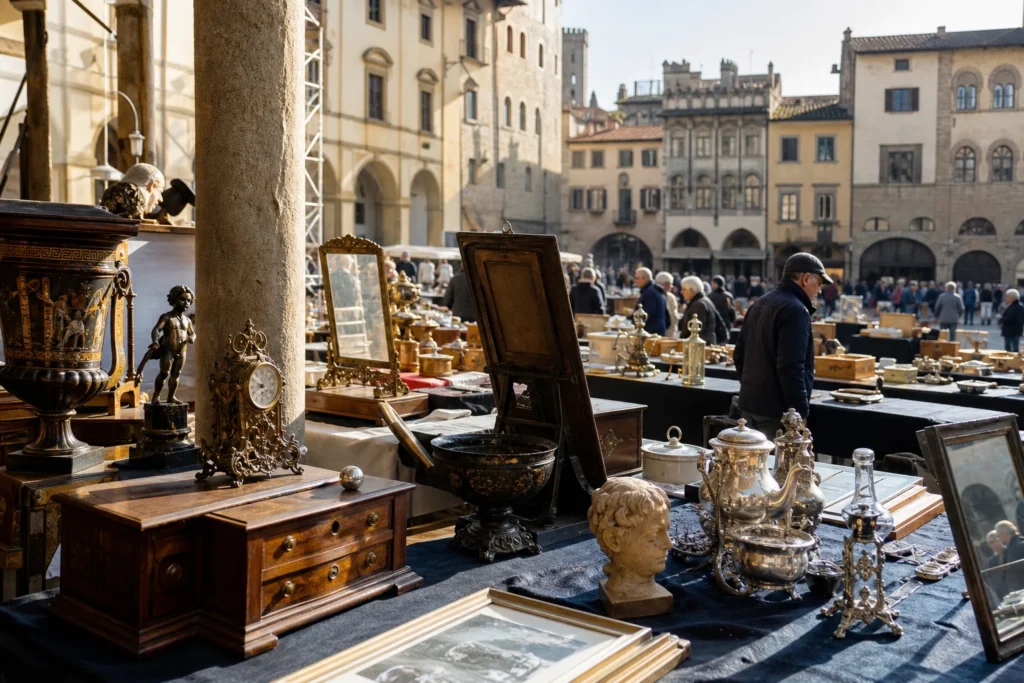

On the first Saturday and Sunday of every month, Arezzo gives itself over entirely to antiques. Stalls spread from Piazza San Francesco and the grand slope of Piazza Grande through the alleys and side squares of the medieval centre, filling streets that otherwise belong to daily Tuscan life. The Fiera Antiquaria di Arezzo has run this way since 1968, making it one of Italy's oldest and most consistently attended antique fairs.
The scale is considerable. Around 500 exhibitors arrive from across Italy, bringing a genuine regional spread of objects, styles and traditions. Organiser estimates put attendance at roughly 20,000 visitors per edition — a figure that reflects the fair's pull well beyond Tuscany. The two-day format, running from 08:00 to 19:00 on both days, gives visitors enough time to work through the main squares and still explore the side streets at a reasonable pace.
The browsing experience divides naturally into two distinct worlds. The generalist stalls reward patience and an open eye: antique furniture sits alongside tarnished silverware, Roman coins, old-fashioned telephones, painted porcelain, candlesticks and battered clocks. Pieces arrive mixed without obvious order, leaving the visitor the genuine pleasure of discovery. These stalls suit anyone curious about the past, with no fixed agenda and no specialist knowledge required.
The fair's other register belongs to the specialist dealers. Serious collectors come for old books, scientific instruments, Art Deco objects, jewellery, watches, 19th- and 20th-century paintings, liberty glasswork and classical archaeology. Arezzo also hosts around 100 antique shops open year-round, and some of these align closely with the fair's rhythm. A handful focus on deep specialism — selected pieces, carefully sourced — rather than general display. These are the destinations for researchers with a specific quarry in mind.
The medieval setting amplifies everything. The Logge del Vasari frames one edge of the market, and the stonework of Piazza Grande provides a backdrop that no convention centre could replicate. The fair transforms the character of the city for its two days, but it belongs to Arezzo rather than interrupting it. That integration with a living historic city gives the Fiera Antiquaria a depth that purely commercial antique events rarely achieve.
What has kept the fair relevant across more than five decades is exactly this combination: genuine scale, specialist depth and a setting that makes the visit worthwhile on its own terms. Committed collectors and first-time browsers move through the same streets, and the exhibitors — many of whom are long-standing participants — are generally willing to explain, discuss and negotiate.
Arezzo train station, on the Ferrovia Roma–Firenze line, sits approximately 600 metres from Piazza San Francesco and makes arriving by train the most practical choice for visitors from Florence, Rome or Perugia. Local bus stops at Arezzo Guido Monaco, roughly 300 metres away, and Via Petrarca 1, approximately 450 metres away, offer additional options for those already in the area. Distances are approximate straight-line distances rather than measured walking routes.
Frequently Asked Questions
Q: When does the Fiera Antiquaria di Arezzo take place?
A: The fair runs on the first Saturday and Sunday of every month, from 08:00 to 19:00 on both days. The two-day format gives visitors plenty of time to cover the main squares and explore the side streets at a manageable pace.
Q: How big is the fair, and what kind of things can I expect to find?
A: Around 500 exhibitors set up across Piazza San Francesco, Piazza Grande and the surrounding alleys. The range spans generalist stalls — antique furniture, silverware, clocks, Roman coins, painted porcelain, old telephones — through to specialist dealers focused on areas such as old books, scientific instruments, Art Deco objects, jewellery, watches and 19th- and 20th-century paintings. Pieces on the generalist stalls arrive mixed without obvious order, so browsing without a fixed agenda works just as well as arriving with a specific quarry.
Q: Is Arezzo easy to reach by public transport on fair days?
A: Arezzo train station sits on the main Rome–Florence rail line and is roughly 600 metres from Piazza San Francesco, making it a walkable arrival point from the platform. Trains connect from both Florence and Rome, which makes a day trip or weekend visit straightforward without a car.
Q: Are there antique shops to visit beyond the fair stalls themselves?
A: Yes. Around 100 antique shops operate in Arezzo year-round, and many align closely with the fair's rhythm. Some carry a similarly varied mix of objects; others are specialist destinations with carefully selected stock, suited to collectors researching a particular field. Combining the open-air stalls with the permanent shop circuit makes for a fuller visit.
Q: Is this fair worth attending for a first-time visitor with no collecting background?
A: Very much so. The medieval setting — Piazza Grande framed by the Logge del Vasari, stalls spilling through stone alleys — makes the visit worthwhile on its own terms. The fair has run continuously since 1968 and draws around 20,000 visitors per edition, but the atmosphere remains rooted in the city rather than feeling like a trade event. Exhibitors are generally willing to talk through pieces, and the generalist stalls reward curiosity over expertise.
Marketplace Highlights








Add a review