

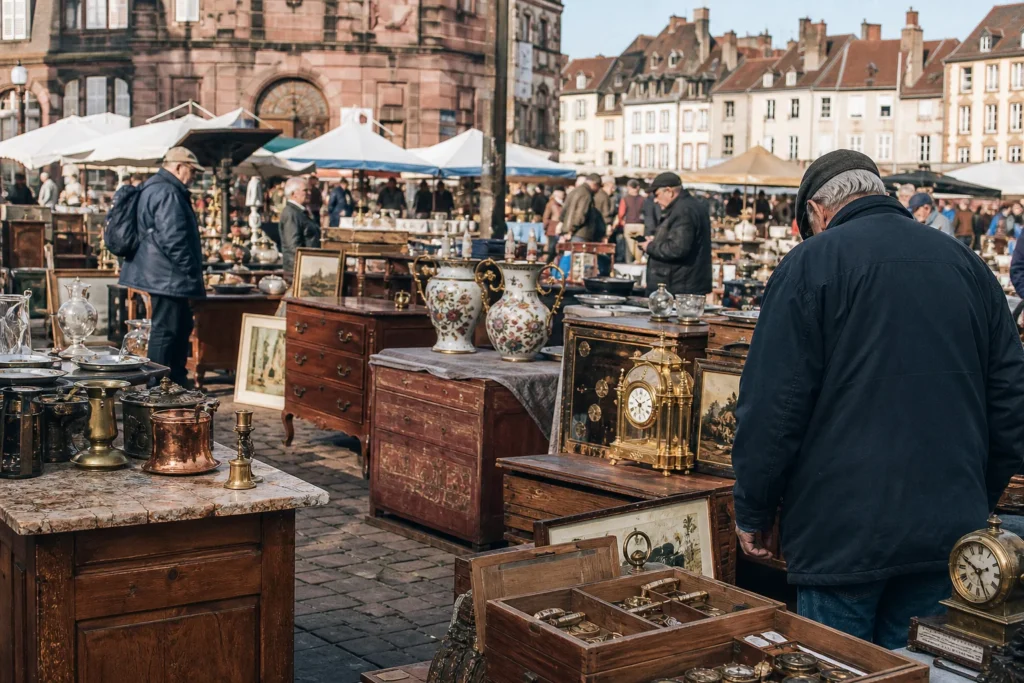

Painted Alsatian milk jugs, Lorraine earthenware, precision clocks rooted in a century-old watchmaking tradition — the stalls of the Brocante de Belfort carry a regional fingerprint that sets it apart from a generic provincial antiques market. Each month, Place d'Armes and Place de l'Arsenal fill with traders and browsers, and the activity extends along several streets in the walkable city centre of Belfort, eastern France. The market draws a purposeful crowd from the first moment the stalls open.
Belfort sits at a geographical crossroads that shapes everything on offer. The town lies where Alsace, Lorraine and the Franche-Comté converge, and that position feeds the market directly. Ceramics and domestic objects from all three regions surface regularly here, and the long watchmaking tradition of nearby Besançon gives the clock and timepiece stalls a particular depth. Buyers travel across from Alsace and down from Switzerland to browse — not because the market is conveniently placed, but because the quality justifies the journey.
Collectors of regional French ceramics find especially rich pickings. Alsatian milk jugs with traditional floral decoration, Lorraine baking molds and rustic earthenware appear with a frequency that feels deliberate rather than accidental. A second cluster of finds centres on precision clocks, copper pieces and vintage metalwork, where the Franche-Comté connection runs deep. Broader finds — glassware, paintings, books, toys, vintage furniture and military memorabilia — fill out the market without overwhelming the regional character. The mix shifts month to month, giving regulars reason to return.
The Brocante de Belfort runs on the first Sunday of each month from 08:00 to 12:00, pausing in January and February. That four-hour morning window moves quickly, so arriving early rewards the most focused collectors. The surrounding city centre — cafés, covered streets, a compact historic core — makes it easy to extend the morning once the stalls wind down.
Getting there by bus is straightforward. The République stop is the closest option, approximately 229 metres away, with a wide range of city bus lines including 1, 2, 9, 21, 22, 24, 32, 33, 34 and 35. The Universités stop, roughly 279 metres away, serves bus lines 9, 33, 34, 35 and M and offers a useful alternative. Both stops are bus-only — no metro or tram serves this part of Belfort directly.
The Brocante de Belfort suits collectors who know what they are looking for. Anyone with a specific interest in Alsatian ceramics, Lorraine kitchenware or the horology of Franche-Comté will find a level of focus here that larger, more general markets rarely match. Cross-border visitors from Alsace and Switzerland have clearly already worked that out.
Frequently Asked Questions
Q: When does the Brocante de Belfort take place?
A: The market runs on the first Sunday of each month from 08:00 to 12:00, pausing in January and February. That gives you a tight four-hour window, so arriving early is worthwhile — especially if you are after specific pieces. Check the official Belfort municipal calendar before travelling, as dates can shift around public holidays.
Q: What kinds of finds is this market known for?
A: The market has a strong regional character. Collectors tend to focus on Alsatian painted ceramics, Lorraine earthenware and baking molds, and precision clocks connected to the Besançon watchmaking tradition. Copper pieces, vintage glassware, furniture, books, toys and military memorabilia also appear regularly, and the mix shifts from month to month.
Q: Why do buyers travel from Switzerland and Alsace to shop here?
A: Belfort sits at the junction of Alsace, Lorraine and the Franche-Comté, which directly feeds the quality and character of the stock. Cross-border visitors make the trip for the regional depth — particularly the ceramics and horology — rather than simply for convenience.
Q: How do I get there by public transport?
A: The République bus stop is the closest option at approximately 229 metres, served by multiple city lines including 1, 2, 9, 21, 22, 24, 32, 33, 34 and 35. The Universités stop, roughly 279 metres away, is a useful alternative with lines 9, 33, 34, 35 and M. Both stops are bus only — no metro or tram serves this part of the city centre directly.
Q: Is there anything to do once the market closes at noon?
A: The market occupies a walkable part of Belfort's city centre, and the area has cafés and a compact historic core worth exploring once the stalls wind down. It makes for a natural extension of the morning.
Marketplace Highlights








Add a review