

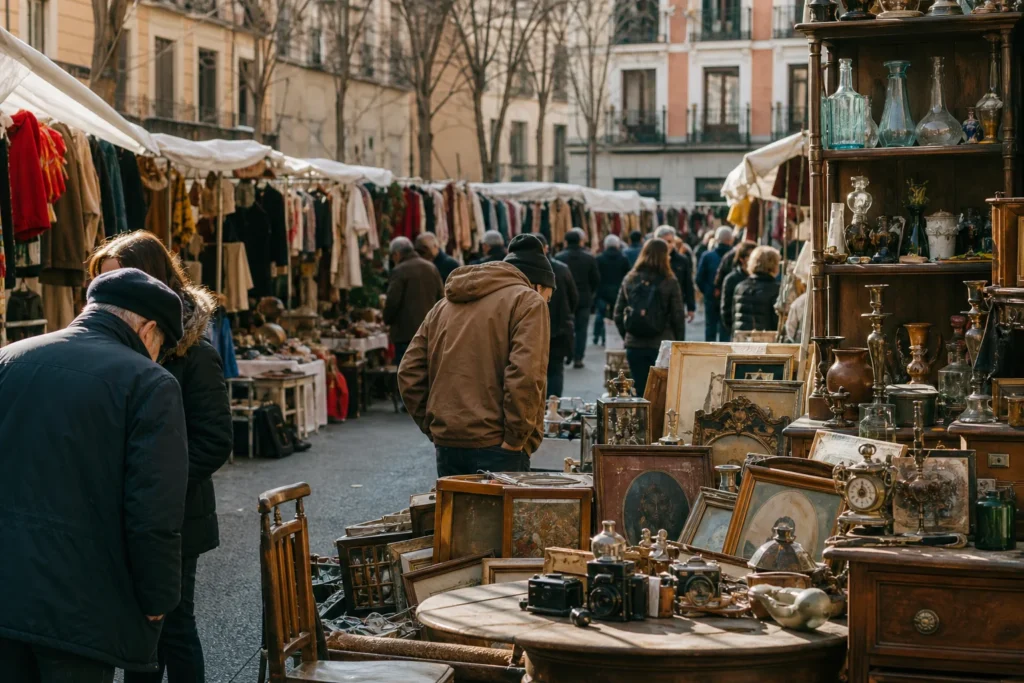

El Rastro has occupied the same wedge of southern Madrid for more than five centuries. Its core runs along Ribera de Curtidores, bounded by Calle de Toledo, Calle Embajadores and Ronda de Toledo — a roughly triangular grid that expands into side streets, open squares and permanent shopfronts on Sunday mornings. Walking the full circuit from Plaza de General Vara del Rey to Plaza de Campillo del Mundo Nuevo takes longer than first-timers expect. This is genuinely one of the largest open-air markets in Europe.
Understanding the two distinct layers of the market makes a visit far more rewarding. The main thoroughfares deliver a broad street-stall experience: secondhand clothing, trinkets, vintage photographs of Madrid, retro jewellery, old door hardware, film-era cameras and stacks of vinyl. These stalls are democratic and densely packed, and the atmosphere is half the draw. The side streets — Carlos Arniches, San Cayetano, Mira el Río — offer a different register entirely. Smaller vendors and permanent antique galleries cluster here, carrying mid-century furniture, genuine antiques and curated vintage goods. Several shops in the Ribera de Curtidores area open specifically on Sundays to catch the market crowd. Serious collectors usually head straight for these quieter streets.
El Rastro does not aim to be Paris's Marché aux Puces or London's Portobello Road at its most polished. It is an openly democratic street market where quality varies widely and nothing is guaranteed. That honesty shapes its character entirely. Prices are generally low, negotiation is expected, and the charm is partly in the uncertainty. Genuine finds exist — but they reward patience and a willingness to dig.
The Sunday rhythm matters here. Arriving by around 8:30 or 9:00 gives the clearest access to stalls and the best conditions for negotiating. By about 11:00, the market hits peak density — noisier, more festive and considerably harder to move through. From midday onward, the crowd drifts toward the tapas bars and terraces around nearby Plaza de Cascorro, and vendors gradually begin to wind down through early afternoon. An early start consistently improves the experience.
Getting there is straightforward. La Latina Metro station on line L5 sits approximately 220 metres from the market — the most direct public transport option for most visitors. The Toledo-Humilladero bus stop is even closer, around 130 metres away, with buses 002, 17, 18, 23, 35, 60 and the night bus N26 all serving it. Those coming by Cercanías can use Embajadores station on line C-5, roughly 640 metres from the market centre.
El Rastro suits a wide range of Sunday visitors. Vintage and antique collectors will find the side-street layer worth an early arrival. Casual browsers come for the street energy and leave with something unexpected. Either way, comfortable shoes and an unhurried morning are the only real requirements for getting the most from Madrid's oldest and largest flea market.
Frequently Asked Questions
Q: When does El Rastro take place, and what are the best hours to arrive?
A: El Rastro runs on Sunday mornings. Arriving around 8:30 to 9:00 gives you the clearest run through the stalls and the best conditions for negotiating. By around 11:00 the market hits peak density and becomes considerably harder to move through. From midday onward, vendors begin winding down and the crowd drifts toward the tapas bars and terraces around nearby Plaza de Cascorro.
Q: Is El Rastro good for serious antique and vintage collectors, or is it more of a casual browse?
A: It rewards both, but with different strategies. The main thoroughfares along Ribera de Curtidores carry a broad mix of secondhand clothing, curiosities, vinyl and trinkets — good for casual browsing. The side streets (Carlos Arniches, San Cayetano, Mira el Río) and the permanent gallery shopfronts are where serious collectors tend to head first, as smaller vendors and antique shops cluster there with mid-century furniture, curated vintage goods and genuine antiques. An early Sunday start helps most on those quieter streets.
Q: How do I get to El Rastro by public transport?
A: La Latina Metro station on Line 5 is the most direct option, sitting approximately 220 metres from the market. The Toledo-Humilladero bus stop is even closer at around 130 metres, served by buses 002, 17, 18, 23, 35, 60 and night bus N26. Travellers arriving by Cercanías train can use Embajadores station on line C-5, roughly 640 metres away.
Q: Should I expect to negotiate on prices?
A: Yes — haggling is a normal part of the El Rastro experience. Prices across the stalls are generally low and negotiation is expected, particularly on the open street stalls. Quality varies widely across the market, so the willingness to dig and to bargain is part of what makes genuine finds possible.
Marketplace Highlights









Add a review