

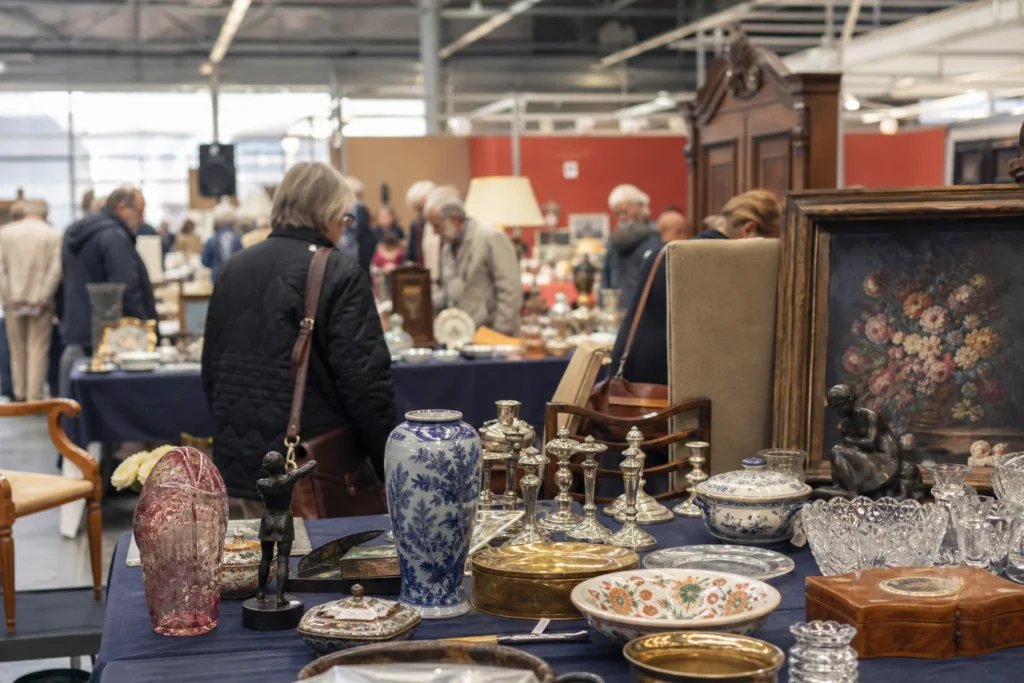

Every July, week 30 in the Swedish calendar, Helsingborg Arena fills with the kind of quiet, focused energy that only a serious antique fair generates. Dealers arrange silver and porcelain with the care of a museum installation. Collectors circle back for the third time before committing. Helsingborgs Konst & Antikmässa has operated this way since 1962, making it one of the longest-running summer antique fairs in Scandinavia.
The fair runs across four days, opening on Wednesday at 10:00 and staying open until 21:00 — an extended evening that makes it unusually accessible for visitors crossing from Copenhagen or arriving from Malmö after work. Thursday through Saturday the doors open at 10:00 and close at 18:00. Sunday wraps up at 16:00. The indoor arena format keeps the experience comfortable regardless of summer heat, and the layout handles large crowds without feeling congested.
The hall dedicated to members of the Swedish Art and Antique Dealers' Association is the fair's clearest statement of intent. These dealers operate under shared professional standards, with provenance and piece condition as non-negotiable criteria. Stands are arranged to show individual objects at their best — not stacked, not hurried. For a collector focused on Scandinavian furniture, historical silver or early ceramics, this section alone justifies the journey.
Beyond the association hall, the fair opens into a broad range of exhibitors and categories. Furniture appears in every scale, from small occasional pieces to substantial case furniture. Carpets, textiles and sculpture sit alongside works on paper, paintings and prints. Applied arts — ceramics, porcelain, glass, silver and jewellery — make up a substantial portion of the floor. Prices span a wide range, from accessible decorative objects to museum-grade pieces. That breadth makes the fair genuinely useful whether you are adding a single object to a collection or sourcing at a higher level.
What keeps this fair distinct from a general vintage market is its curation policy. Organisers accept only verified antiques and quality items — no contemporary reproduction, no general bric-a-brac. That editorial standard has built a loyal, returning audience over decades. The event is said to attract more than ten thousand visitors each year, a figure that reflects genuine demand from collectors across the region.
Helsingborg itself adds real value to the visit. The city sits on the Øresund strait, directly opposite Helsingør in Denmark, with a compact historic centre that rewards an afternoon on foot. Visitors combining the fair with a day in the city will find the geography well suited to that kind of pairing.
Getting there by bus is straightforward. The Helsingborg Olympia Park stop sits approximately 150 metres from the arena, served by buses 6, 25, 220, 250, 506, 520 and SkåneExpressen 10. An alternative stop, Helsingborg Fredriksdalsplatsen, lies around 300 metres away and connects buses 7, 26 and 27. Helsingborg is also well linked by rail to Malmö and, via the Öresund connection, to Copenhagen — making the fair a realistic day or weekend trip from either city.
This is a fair that rewards collectors who value curation over volume. The association hall offers a level of dealer accountability rare outside the major European auction circuit. The four-day format, the Wednesday evening opening and the city setting combine to make Helsingborgs Konst & Antikmässa one of the most purposeful stops on the Scandinavian antique calendar.
Frequently Asked Questions
Q: When does Helsingborgs Konst & Antikmässa take place, and what are the opening hours?
A: The fair runs over four days in week 30 of the Swedish calendar, typically in July. Wednesday opens at 10:00 and stays open until 21:00 — an unusually generous evening slot. Thursday through Saturday the hours are 10:00–18:00, and Sunday closes at 16:00. Check the organiser's official page before you go to confirm the exact dates for the current year.
Q: What kind of items will I find at the fair?
A: The fair covers a broad range of verified antiques and quality pieces: furniture of all scales, carpets and textiles, paintings, works on paper, sculpture, and applied arts including silver, ceramics, porcelain, glass and jewellery. Prices run from accessible decorative objects through to museum-grade pieces, making it useful for collectors at different levels.
Q: Is there a section specifically for professional antique dealers?
A: Yes. One dedicated hall brings together members of the Swedish Art and Antique Dealers' Association, who operate under shared professional standards with a clear emphasis on provenance and piece condition. Serious collectors often treat this hall as their first — and sometimes most important — stop of the visit.
Q: How do I get to Helsingborg Arena by public transport?
A: The Helsingborg Olympia Park bus stop is close to the arena. Helsingborg is also well connected by rail, making it straightforward to reach from Malmö or from Copenhagen via the Øresund crossing to Helsingør and onward by train.
Q: Is this a general flea market or a curated antique fair?
A: It is a curated antique fair, not a general market. Organisers accept only verified antiques and quality items — no contemporary reproductions or bric-a-brac. That editorial standard, maintained since 1962, is what distinguishes the event and has built its loyal returning audience over more than six decades.
Marketplace Highlights








Add a review