

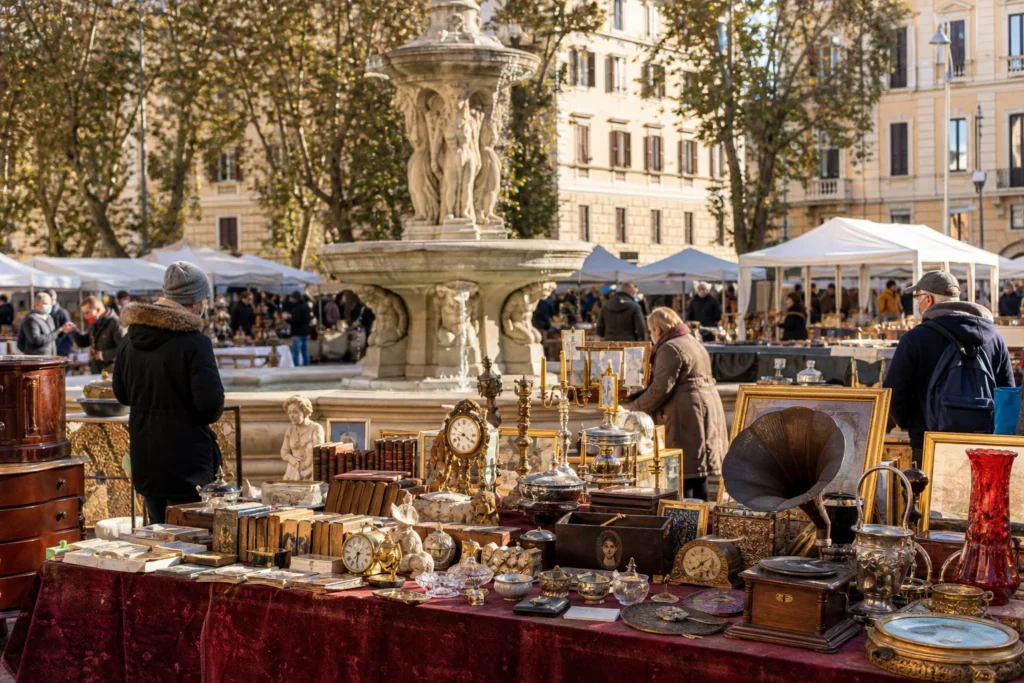

At the centre of Piazza dei Quiriti stands Attilio Selva's Fountain of the Caryatids, a sculptural presence that gives this quiet Prati square an identity well beyond the usual Roman grid. When the Mercatino dell'Antiquariato di Piazza dei Quiriti runs in its regular form, it arranges itself around that fountain — roughly forty stalls spreading outward across the stone, filling the piazza with the kind of carefully sourced material that belongs to the serious end of Rome's antique market scene. Visitors should confirm current scheduling before making the trip, as the market has been on hiatus and its programme is subject to change.
The scale feels considered rather than overwhelming. Dealers here tend to be specialist and knowledgeable, the kind who can date a clock movement or place a print within a particular Roman print house. Antique timepieces, gramophones and oil paintings appear regularly, alongside illustrated periodicals, old books and vintage comics. Porcelain and decorative objects fill the gaps between the larger pieces, and browsing between categories feels natural rather than forced. The stock leans toward provenance and quality — this is not a general flea circuit, and the atmosphere reflects that.
Roman antiques give the market a character you won't easily replicate elsewhere in the city. Prints, drawings and clocks tied to Rome's own material culture surface here more reliably than at the broader weekend markets. The pieces carry histories — objects from apartments that no longer exist, from households that furnished themselves across decades of twentieth-century Roman life.
Prati adds its own value to a market visit. The neighbourhood sits just north of Castel Sant'Angelo, a grid of wide streets with independent cafés and a pace that encourages lingering. The piazza itself stays composed even on well-attended market days. Arriving early puts you in the best light and gives first access to stock before the late-morning crowd arrives and dealers begin to pack away.
Prices reflect the quality register. Bargain hunters working the lower end of the flea market circuit may find the going competitive. The market rewards those who already know what they are looking for — a collector tracking a specific period, or a visitor who wants something genuinely rare rather than a reproduction. Curious non-specialists are welcome, but the best conversations here happen with people who come prepared.
For public transport access, Lepanto on Metro line A sits approximately 240 metres away and serves as the most direct connection into the neighbourhood. The Giulio Cesare/Fabio Massimo bus stop, roughly 180 metres away, is served by bus lines 70, 990 and night bus n913, making it useful for visitors approaching from elsewhere in the city. Flaminio — approximately 1,070 metres away — is served by the Roma Viterbo Extraurbana train and the Roma Viterbo Urbana light rail line, and works as a practical alternative for those travelling from the north.
Frequently Asked Questions
Q: What kind of antiques does the Mercatino dell'Antiquariato di Piazza dei Quiriti specialise in?
A: The market sits at the higher end of Rome's antique circuit. Serious collectors come for antique clocks, gramophones, prints and oil paintings with Roman provenance. Illustrated periodicals, old books, vintage comics, porcelain and decorative objects round out the range. The stock leans toward quality and traceable history rather than general flea-market fare.
Q: How big is the market and what is the atmosphere like?
A: Around forty stalls spread across Piazza dei Quiriti, arranged around Attilio Selva's Fountain of the Caryatids at the centre of the square. The pace is unhurried and dealers tend to be knowledgeable specialists — the kind willing to date a piece or discuss its provenance. It rewards both purposeful collectors and curious browsers, though it suits people who come with some preparation.
Q: When is the best time to arrive?
A: Early arrival gives you the best light and first access to freshly laid-out stock before the late-morning crowd moves in. The piazza stays composed even on well-attended days, but pieces at this quality level can move quickly once the serious morning visitors arrive.
Q: How do I get to Piazza dei Quiriti by public transport?
A: Lepanto on Metro line A is approximately 240 metres away and is the most direct option. The Giulio Cesare/Fabio Massimo bus stop, around 180 metres from the piazza, is served by bus lines 70, 990 and night bus n913 for visitors approaching from other parts of the city.
Q: Is the market currently running?
A: The market has been on hiatus and its schedule is subject to change. Check the organiser's official channels before making the trip to confirm current dates.
Marketplace Highlights









Add a review