

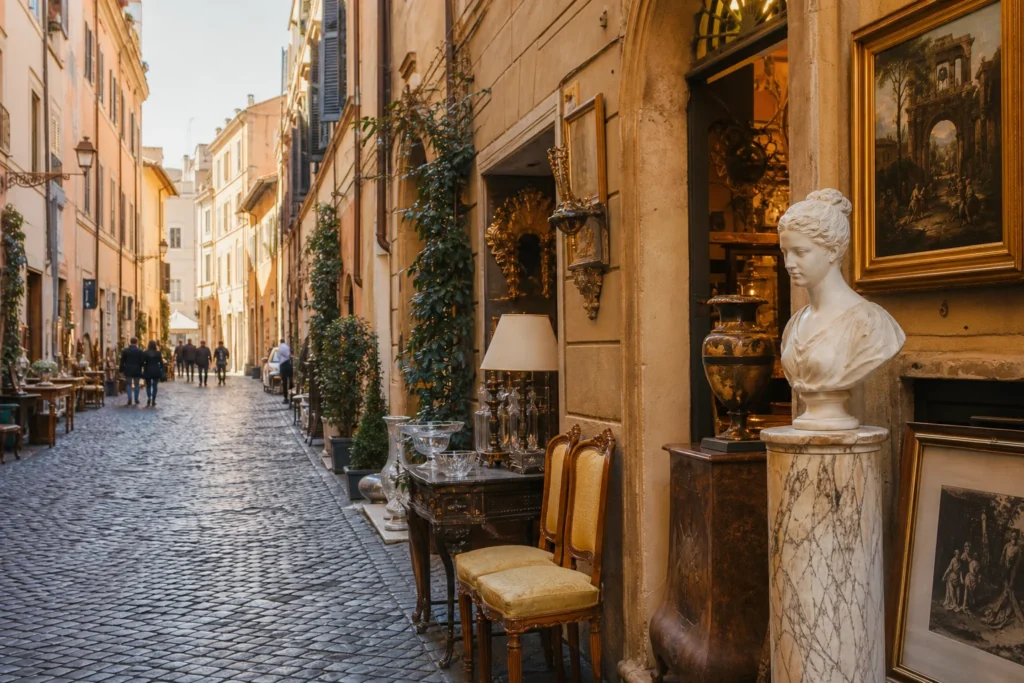

Most of Rome's secondhand markets run only at weekends, and several open just once or twice a month. Via dei Coronari breaks that pattern entirely. This cobbled street near Piazza Navona runs for roughly 500 metres and hosts a concentration of specialist antique dealers operating Monday through Saturday, 10:00 to 19:00, with Sunday visits possible by appointment. For anyone planning a Rome trip around serious browsing, that weekday access alone makes it worth marking on the map.
The street moves at a different pace from the rest of central Rome. Locals linger over coffee at pavement tables, and pedestrians tend to slow down naturally as they pass the shop windows. Corner niches above old-fashioned street lamps hold small religious sculptures — remnants of the street's medieval identity as a pilgrims' route toward St Peter's Basilica. The coronary sellers of rosaries who once traded here gave the street its name, and something of that layered history still clings to the stone.
Two of the street's most ambitious galleries anchor the fine art and sculpture end of the spectrum. Galleria dei Coronari at No. 59 was established by an unusual trio — a mathematician, an art historian and an archaeologist — whose expertise overlaps in productive ways. The gallery deals in antique sculptures, ornate mirrors, bronze figures and works of art, and it carries its stock to international antiques fairs including the Biennale di Venaria Reale. Further along at No. 79, Arte Antica Rufini brings decades of specialist experience to a similarly serious range of paintings and decorative pieces, issuing authentication photographs with purchases — a reassuring policy that distinguishes it from more casual dealers.
The decorative arts occupy their own strong corner of the street. Art Deco Gallery at No. 14, founded in 1986, concentrates on the period from the 1890s to the 1940s: paintings, sculpture, lighting and Italian and French furniture. Its shelves hold glamorous dancing figures, carved wooden cabinets and grand floral vases. The owners are genuinely welcoming, and browsers regularly spend far longer inside than they intended. Blu Old Sheffield at No. 37 takes a different angle, filling its blue-doored interior with silverware — trays, candelabras, serving plates and picture frames — that rewards anyone with an eye for metalwork. Antiqua Res at No. 32 sits almost directly opposite and offers an eclectic selection of twentieth-century secondhand goods for shoppers who prefer a broader mix.
Between the galleries, the street also holds independent fashion retailers, jewellery shops and a scattering of coffee stops. None of it feels hurried. The combination of specialist depth and unhurried atmosphere is relatively rare this close to Piazza Navona, and it makes longer browsing sessions feel natural rather than exhausting.
Via dei Coronari suits collectors and decorative arts enthusiasts who want real expertise available across the working week. It also rewards culturally curious visitors who appreciate context alongside the objects — dealers here tend to know their stock well and are usually willing to talk about it. The street is not a rummage market, and prices reflect that; but the range of specialisms across just 500 metres is genuinely unusual for a single street.
For access, bus 280 stops at Lgt Tor di Nona/Zanardelli approximately 130 metres from the street — the most straightforward public transport option. The Sant'Angelo ferry landing, served by the Battelli di Roma service, sits approximately 220 metres away and makes for a more atmospheric arrival if you are travelling along the Tiber. No metro station is immediately close, but the street is easily reached on foot from the historic centre.
Frequently Asked Questions
Q: Is Via dei Coronari worth visiting on a weekday, or is it mainly a weekend destination?
A: Weekdays are actually ideal. Most of Rome's secondhand and antique markets only operate at weekends, but the dealers along Via dei Coronari are generally open Monday through Saturday, roughly 10:00 to 19:00. That makes it one of the few places in central Rome where you can browse seriously mid-week without adjusting your whole itinerary around a Saturday.
Q: What kind of antiques and objects are the dealers here known for?
A: The street covers a fairly serious range. At one end you'll find galleries dealing in antique sculptures, bronze figures, ornate mirrors and paintings — the kind of stock that travels to international antiques fairs. Elsewhere on the street there are dealers specialising in Art Deco decorative arts from the 1890s to the 1940s, silverware including trays and candelabras, and more eclectic twentieth-century secondhand pieces. It skews toward specialist and decorative rather than casual bric-a-brac.
Q: Can I visit on a Sunday?
A: Sunday visits are possible at some dealers but typically by appointment rather than walk-in. If you're planning a Sunday trip specifically, it's worth contacting individual shops in advance to confirm availability.
Q: Do the galleries here provide any documentation with purchases?
A: At least one of the established galleries on the street — Arte Antica Rufini at No. 79 — issues authentication photographs with purchases, which is a more rigorous practice than you'll find at many dealers. If provenance documentation matters to you, it's worth asking each gallery directly about their policy before buying.
Q: How long should I allow for a proper visit to Via dei Coronari?
A: Half a day is a reasonable minimum for anyone genuinely interested in the antiques. The street is around 500 metres long and the shops reward slow browsing — visitors frequently spend far longer inside individual galleries than planned. There are also coffee stops along the way, and the unhurried pace of the street itself tends to stretch any visit naturally.








Paul
30th March 2017 at 23:27Rome’s Via Dei Coronari has got to remain the best place I have ever visited among all flea markets worldwide. No other place on earth seems to compare to Rome’s antiques market both in terms of merchandise and the beauty of the location.