

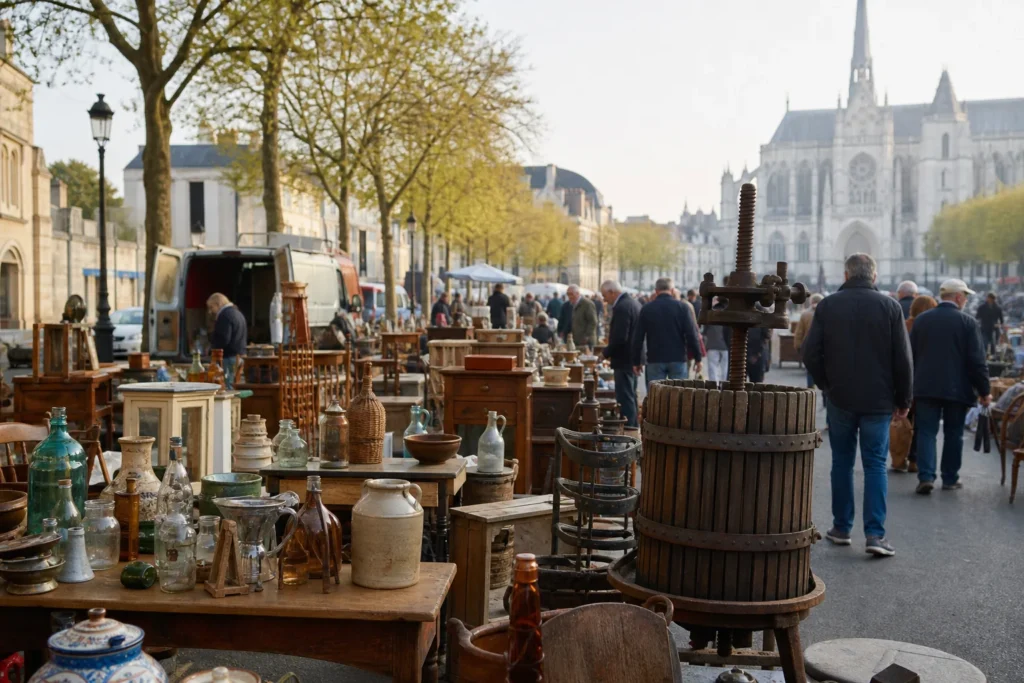

The Orléans flea market runs every Saturday morning on boulevard Alexandre-Martin, a broad esplanade sitting almost in the shadow of the city's gothic cathedral. Around ninety dealers set up here each week, drawing collectors, weekend browsers and curious visitors into one of the Loire Valley's more characterful brocante gatherings. The scale feels well-judged — substantial enough to warrant a proper morning, compact enough that the atmosphere stays sociable rather than overwhelming.
The stock has a distinctly regional personality. Loire Valley rural life shapes much of what dealers bring: galvanised buckets, wooden-handled tools, stoneware jugs, wicker baskets and wine-making equipment appear with regularity. Fishing rods and tackle surface too, a quiet nod to the river culture that runs through this part of France. These utilitarian pieces attract specialist collectors as much as casual browsers, and they give the market a grounded, local identity.
Beyond the agricultural core, the selection broadens considerably. Antique ceramics, porcelain, framed paintings, linen, silverware, old records and small furniture items — occasional tables, bedroom pieces, wooden trunks — fill out the stalls. Some vendors arrange their goods with obvious care, grouping ceramics by period or ordering tools by size. Others spread everything across ground blankets, trusting browsers to do the archaeology. Both approaches reward patience, and the overall quality tends toward solid rather than tired.
Experienced brocante buyers know to arrive early. The moment dealers are still unloading from their vans — what regulars call buying at the cul du camion — is when the sharpest finds disappear. The market opens at 07:00 and runs through to 13:00, giving a generous window but rewarding those who get there first. Across the road, Café Vincent offers a convenient place to regroup mid-browse without straying far from the stalls.
The dealer culture here is unhurried and genuinely sociable. Most vendors enjoy talking through a piece, sharing provenance where they know it, and negotiating without drama. Prices carry a reputation for accessibility relative to the quality on offer, and bargaining feels natural rather than transactional. For visitors newer to French brocante buying, this relaxed atmosphere makes Orléans a comfortable place to start.
The market suits a wide range of visitors: collectors focused on French provincial and rural Loire antiques, Orléans regulars looking for a reliable Saturday morning activity, and Paris-based buyers wanting a strong brocante without a long journey. The cathedral neighbourhood and the city's compact centre make it easy to extend the morning into a broader visit.
Getting here by public transport is straightforward. The Halmagrand stop, less than 50 metres from the market, is served by tram line B and a range of local bus routes. Orléans train station sits approximately 350 metres away and connects to regional TER services including lines 1, 4, 6, 16 and 17, making the market a realistic day trip by rail from Paris or Tours. For those carrying bulkier purchases home, parking is available nearby.
Frequently Asked Questions
Q: What kinds of things can you find at the Orléans flea market?
A: The market has a strong Loire Valley character, so expect rustic agricultural tools, stoneware jugs, galvanised buckets, wine-making equipment and fishing tackle alongside broader brocante fare: antique ceramics, porcelain, framed paintings, linen, silverware, old records and small furniture such as occasional tables, wooden trunks and bedroom pieces. The mix appeals to specialist collectors and casual browsers equally.
Q: When is the best time to arrive?
A: Early is firmly the right answer. The sharpest finds go when dealers are still unloading from their vans — known among regulars as buying at the cul du camion. The market runs on Saturday morning through to the early afternoon, so arriving at opening gives you first pick before the better pieces disappear.
Q: Is bargaining expected, and are prices reasonable?
A: Bargaining is natural and uncomplicated here. Most vendors are happy to talk through a piece, share provenance where they know it, and negotiate without awkwardness. Prices are generally considered accessible for the quality of stock on offer, which makes the market a comfortable starting point for anyone newer to French brocante buying.
Q: How do you get to boulevard Alexandre-Martin without a car?
A: Orléans train station is roughly 350 metres from the market — an easy walk — and is served by TER regional lines connecting to Paris and Tours, making a rail day trip straightforward. If you plan to take larger pieces home, parking is available nearby, which is worth factoring in before you go.
Q: Is there somewhere nearby to take a break mid-browse?
A: Café Vincent sits directly across the road from the market and is a practical spot to regroup, compare finds and grab a coffee before heading back for another sweep of the stalls.
Marketplace Highlights








Add a review