

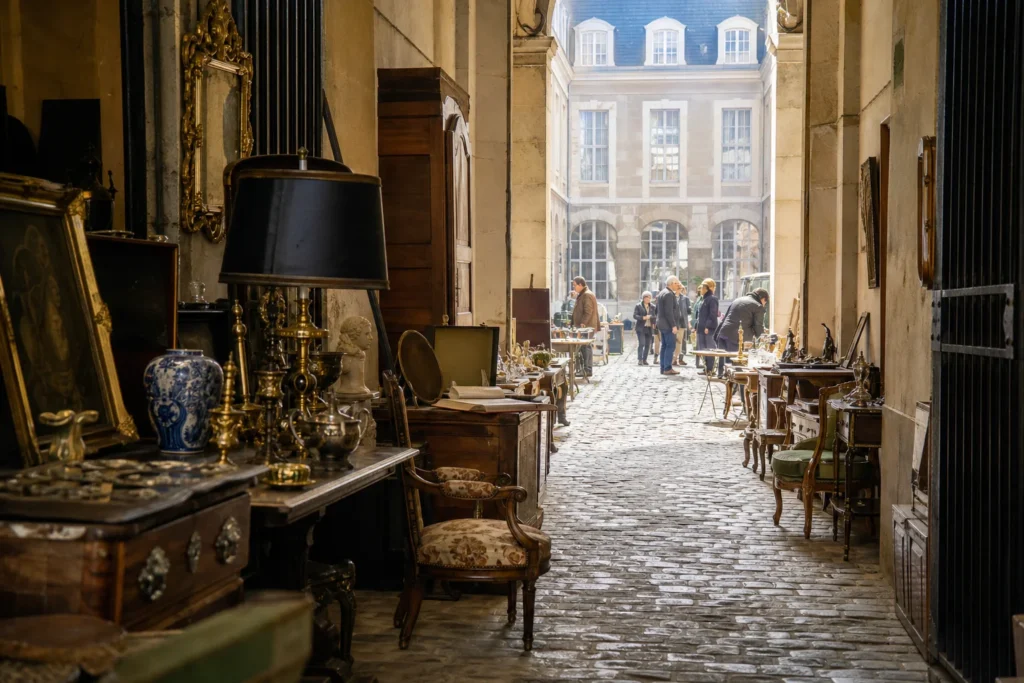

Few antiques districts carry the weight of history that the Quartier des Antiquaires de la Geôle et du Bailliage carries. Wedged between the Château de Versailles, the Notre-Dame market and the Lambinet Museum, this permanent cluster of around fifty dealers, galleries and craftsmen occupies buildings that have served as courts, prisons and stables since the seventeenth century. The past here is not decorative backdrop — it is the architecture itself.
The most imposing anchor is Le Bailliage, an eighteenth-century building constructed in 1724 and attributed to Tavenot, reportedly a pupil in the Mansart tradition. It once housed Versailles's first court and first prison. Today its elegant rooms hold antique furniture, modern paintings and decorative art objects. The transition from judicial severity to refined commerce gives the space an atmosphere few purpose-built antiques centres can match.
From the Bailliage, narrow streets lead into Le Village — former outbuildings of the Hôtel de Picardie, arranged in a horseshoe around a well. A picturesque staircase climbs toward specialist galleries, and a back route connects naturally to the Rue de la Pourvoierie and the Notre-Dame market beyond. Then comes Le Passage, the most dramatically charged section of all. This former prison corridor once housed the office of the executioner Samson, who is associated with the execution of Louis XVI, and reportedly held Madame du Barry during the Revolution. Antique clocks, 17th and 18th century ceramics, faience, glassware, crystal and old paintings now fill the space where those histories unfolded.
Le Carré rounds out the district. Originally the Bailliage's stables, it became a wine warehouse in the nineteenth century — locals once called it the Cour de l'Etape aux Vins. Its courtyards now host galleries, specialist workshops and dealers in arts and crafts, all focused on the material culture of past centuries.
The merchandise across the four areas ranges widely without losing coherence. One pass might turn up 17th to 19th century furniture, antique clocks, porcelain and silverware. Another yields old books, engravings, vintage toys, archaeological fragments or goldsmithery. Jewellery and fine art objects appear throughout. The range suits professional decorators sourcing for projects and private collectors browsing without a fixed brief equally well. Individual shops generally open Tuesday through Sunday from 11:00 to 19:00, though hours vary by dealer and a quick check with each venue is sensible before making a special journey.
The physical experience of the district matters as much as the stock. Covered passages, inner courtyards and connecting alleys slow the pace in the best possible way. Sellers here are mostly specialist dealers rather than general traders, and direct conversation tends to be substantive. The proximity to the open-air Notre-Dame market makes a natural half-day pairing for anyone serious about Versailles beyond the palace.
Getting here is straightforward. The Place du Marché Notre-Dame bus stop sits approximately 60 metres away and serves bus lines 1, 3, 5, 6202, 6205, D and E. Versailles Rive Droite station, served by Train Line L, is around 350 metres away and offers a direct connection from Paris Saint-Lazare. Versailles Château Rive Gauche, on RER Line C, is roughly 800 metres distant for visitors arriving from central Paris via the left bank.
Frequently Asked Questions
Q: What kinds of antiques and collectibles can I expect to find here?
A: The roughly fifty dealers across the four sections cover a wide range: 17th–19th century furniture, old paintings, faience, porcelain, glassware and antique clocks sit alongside jewellery, silverware and goldsmithery. A separate cluster of specialists handles old books, engravings, vintage toys and archaeological fragments. The mix suits both professional decorators with a specific brief and private collectors browsing open-endedly.
Q: Is the district open every day, or are there days to avoid?
A: Individual shops generally open Tuesday through Sunday from 11:00 to 19:00, with Monday typically a rest day. Hours can vary by dealer, so if you are travelling specifically for one gallery or specialist, check with them directly before you go.
Q: Do I need to visit all four sections, or is one area more concentrated than the others?
A: Each of the four sections — the Bailliage, the Village, the Passage and the Carré — has its own character and specialist mix, and they connect through narrow streets and covered passages. The circuit is compact enough to walk in sequence; passing through all four in a single visit is realistic and gives a much fuller picture of what the district holds.
Q: What makes this antiques quarter different from a typical flea market?
A: The sellers here are specialist dealers and gallery owners rather than general traders, so stock tends to be curated and expertise is close at hand. The buildings themselves add to the experience — the 1724 Bailliage, the former prison corridor of Le Passage and the converted stable courtyards of Le Carré give the district a historical atmosphere that purpose-built antiques centres rarely match.
Q: Is the Quartier easy to reach without a car?
A: Versailles is well served by rail from Paris, and the district sits close to the centre of town near the Château. The adjacent Marché Notre-Dame makes a natural half-day pairing if you want to combine the antiques quarter with a broader market visit.








Add a review