

Region
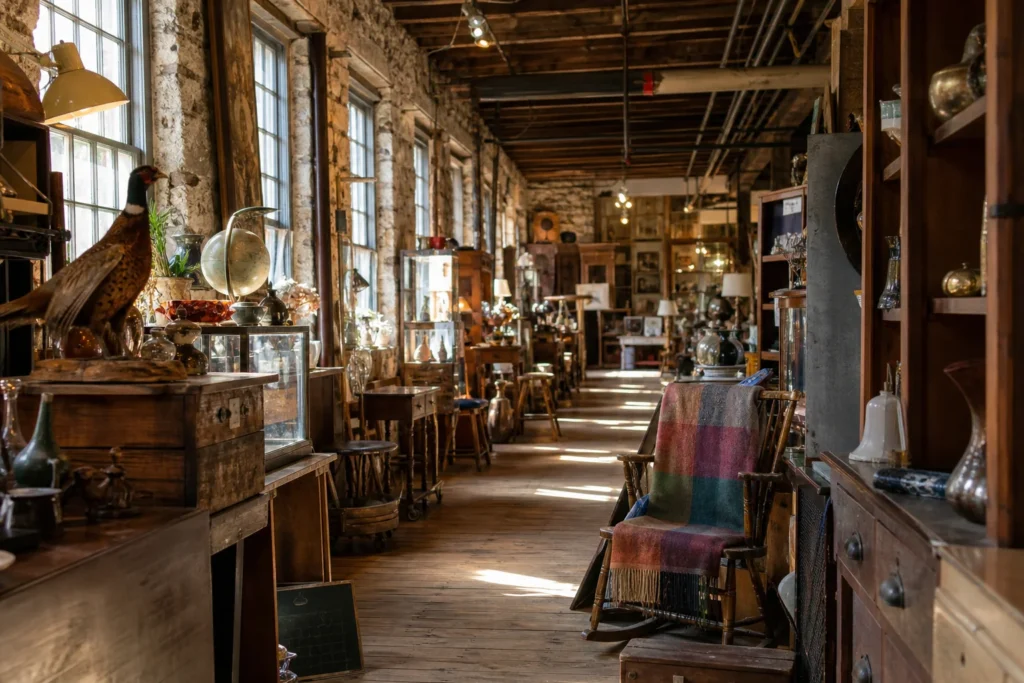
Some buildings hold their age well. The one at 8600 Foundry Street in Savage, Maryland, holds it in a way that shapes everything around it. Stone walls and heavy timber framing from a mill dating to around 1810 give the interior a gravity that purpose-built antique malls simply cannot manufacture. The Little Patuxent River runs close by, and the setting keeps the whole complex unhurried in a way that feels less like a shopping destination and more like a place you wander into and stay longer than intended.
Savage itself sits comfortably between Baltimore and Washington, D.C., which makes the mill an easy day trip from either city. The building was converted for retail use in the mid-1980s, and the antique center has since become its anchor. Around 150 independent vendors operate here, each managing their own space and stock. The result is a floor that reads as a genuine accumulation of individual taste rather than a curated retail concept.
The merchandise ranges widely, and that range is part of the appeal. Art Deco lighting fixtures appear within a few paces of Victorian-era statues. Taxidermy shares wall space with framed artwork from earlier decades. War medals and military ephemera surface with enough regularity to draw serious collectors alongside curious browsers. This is not a market where any one category dominates.
Decorative objects fill a considerable share of the floor. Ornate picture frames, ceramic figurines and vintage textiles claim their space alongside functional antiques. The clothing section offers a real cross-section of twentieth-century fashion rather than a narrow edit of collectible couture. Toy cars, rotary-dial telephones and boxed board games occupy their own territory, and they tend to attract collectors chasing very specific finds from a particular era. Domestic objects — kitchen tools, glassware, everyday items from earlier generations — round out a floor that rewards slow attention.
The layout itself encourages exploration. First-time visitors tend to follow the main corridors. Return visitors know to push further in, where individual dealers arrange stock in ways that take time to read properly. Dealers refresh their displays regularly, so the floor shifts enough between visits to stay interesting. The center opens Monday through Saturday from 10 a.m. to 6 p.m. and is closed on Sundays. Weekday visits tend to be quieter and suit collectors who prefer to browse without competition. Saturday draws a steadier crowd, particularly from the Baltimore and D.C. corridors. Pricing varies by dealer. Some vendors hold firm. Others will talk, especially on larger pieces or when a buyer takes more than one item. Asking directly is always the right move, and carrying cash remains practical for those moments when a dealer prefers it.
The center's reputation has grown largely through word of mouth rather than advertising. That is fitting for a place this unassuming from the outside and this absorbing once you are in.
Bus route 409 runs along Washington Boulevard, with the nearest stop at Washington Blvd / Gorman Rd approximately 800 metres from the venue. A second stop at Washington Blvd / Howard St sits around 900 metres away. That said, the area around Savage is primarily car-oriented, and most visitors arrive by driving. Having your own transport gives you the most flexibility, especially if you plan to carry anything home.
Frequently Asked Questions
Q: When is Savage Mill Antique Center open?
A: The antique center is open Monday through Saturday, 10 a.m. to 6 p.m., and is closed on Sundays. Weekday visits tend to be quieter, which suits collectors who prefer to browse without competition. Saturdays draw a steadier crowd, particularly from the Baltimore and Washington, D.C. corridors.
Q: How many dealers operate here, and what kinds of things can I expect to find?
A: Around 150 independent vendors each manage their own space, so the floor reflects individual taste rather than a single retail concept. Inventory ranges from Art Deco lighting and Victorian-era statuary to war medals, vintage clothing, toy cars, rotary-dial telephones, and domestic objects from earlier generations. No single category dominates, which makes the place worth walking slowly.
Q: Is pricing fixed, or is there room to negotiate?
A: It varies by vendor. Some dealers price firmly; others are open to a conversation, particularly on larger pieces or when you are taking more than one item. Asking directly is always the right move. Carrying cash is practical for those moments when a dealer prefers it.
Q: Is Savage Mill worth a visit if I have been before?
A: Dealers refresh their displays regularly, so the floor shifts enough between visits to stay interesting. Return visitors also tend to push further into the building, past the main corridors, where individual stalls reward the extra attention. The inventory depth supports repeat trips rather than a single browse.
Q: How far is Savage Mill Antique Center from Baltimore and Washington, D.C.?
A: The mill sits in Savage, Maryland, comfortably between both cities. It falls within reasonable day-trip range from either, making it a practical destination for collectors driving from the Baltimore or D.C. metro areas. Check current directions before you go, as the surrounding road layout in older mill complexes can occasionally catch first-time visitors out.
Marketplace Highlights









Add a review