

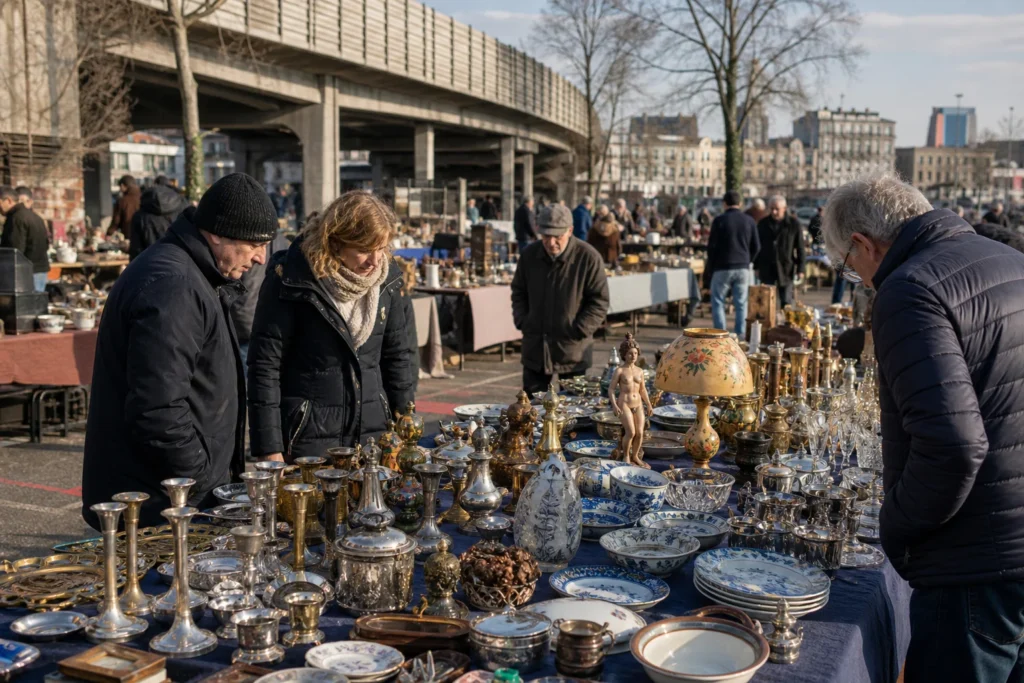

Locals in the streets around Sint-Jansvliet tend to ignore the official market name. They call it Kleine Tunnelplaats, a name tied to the pedestrian tunnel that runs beneath the Scheldt river just steps away. That stubborn preference for the older name is a small but telling detail. This is a neighbourhood market in the truest sense — unhurried, specific, and woven into the weekly rhythm of this part of Antwerp.
Every Sunday from 09:00 to 17:00, the square fills with around 40 traders setting out their stalls. The compact scale is a genuine advantage rather than a drawback. Every seller is visible without backtracking, and vendors at this kind of regular specialist market tend to know their stock well. There are no cavernous hall corners to miss, no distant rows to give up on. You can cover the whole ground slowly and still have time to return for a second look.
The merchandise leans toward the decorative and collectable. Silverware, porcelain, glassware and ornamental objects appear across multiple stalls, and coins turn up reliably enough to make this a worthwhile stop for numismatists. Old books, newspapers and printed ephemera add an archival thread to the mix. Garden tools and the occasional piece of furniture round out the domestic end of the selection, though Sint-Jansvliet rewards collectors of smaller objects more consistently than furniture hunters.
Browsing here works differently from a large fair. At a bigger market, you scan quickly and move on. Here, the pace invites you to look properly — to pick things up, to ask questions, to notice what a first pass missed. Sellers tend to be present with their stock rather than managing a sprawling setup from a distance. That contact makes negotiation feel natural rather than transactional.
The setting strengthens the appeal. Sint-Jansvliet sits close to the St. Anna Tunnel entrance, the covered pedestrian crossing that links Antwerp's old centre to the left bank of the Scheldt. The riverfront is close enough to reach on foot, and the views back across the water toward the city skyline are worth the short detour. Extending a Sunday visit to take in both the market and the riverside is easy and genuinely rewarding.
Antwerp hosts several weekend markets, but most blend antiques with food stalls, lifestyle goods and general secondhand items. Sint-Jansvliet keeps its focus on antiques and older objects. That discipline makes it easier to plan a visit with a purpose and easier to trust that what you find has been considered by the seller. Collectors who care about provenance and specificity will feel at home here in a way that a general market rarely allows.
Getting there by public transport is straightforward. Sint-Andries stop, approximately 345 metres away, serves tram 4 and buses 18, 18a, 18b, 18c and 22. Groenplaats, at roughly the same distance, adds metro access alongside tram 4 and the same bus routes. For visitors arriving by water, the Steenplein ferry landing sits approximately 335 metres from the market — a fitting approach given how strongly the Scheldt defines this corner of the city.
Frequently Asked Questions
Q: When does Antiekmarkt Sint-Jansvliet take place, and how long does it run?
A: The market runs every Sunday from 09:00 to 17:00. That eight-hour window gives you time to arrive early for first pick, leave, and still make it back for a second look at anything you hesitated over.
Q: What kinds of antiques and collectables can I expect to find here?
A: The stalls lean toward decorative and collectable objects — silverware, porcelain, glassware and ornamental pieces appear across multiple vendors. Coins turn up consistently enough to make Sint-Jansvliet a reliable stop for numismatists. Old books, newspapers and printed ephemera add an archival thread, while garden tools and occasional furniture represent the more domestic end of the selection. Smaller-format collectables reward attention here more reliably than large furniture pieces do.
Q: Is Sint-Jansvliet good for negotiating, or are prices fixed?
A: The compact scale — around 40 traders on an open square — means sellers are closely present with their stock rather than managing a sprawling setup from a distance. That proximity makes conversation and negotiation feel natural. Looping back to a stall after a first pass is easy and fairly standard practice at a market this size.
Q: How do I get there by public transport?
A: The two most convenient stops are Sint-Andries (tram 4, buses 18/18a/18b/18c/22, roughly 345 metres away) and Groenplaats (tram 4, the same bus routes, plus metro access, roughly 350 metres away). The Steenplein ferry landing is also within walking distance for anyone coming from the left bank. Confirm current schedules with De Lijn or the relevant operator before travel.
Q: Is there anything worth doing near the market to extend a Sunday visit?
A: The St. Anna Tunnel — the covered pedestrian crossing beneath the Scheldt — is steps from the square, and the riverfront is a short walk beyond it. The views back across the water toward Antwerp's old-city skyline are genuinely good. Combining the market with a walk along the river or a crossing through the tunnel to the left bank makes for a full and unhurried Sunday morning.
Marketplace Highlights








Add a review