

Region
Lawrenceburg, Indiana sits at the point where Indiana, Ohio and Kentucky converge along the Ohio River — a geographic fact that partly explains why a modest river town became home to one of the Midwest's most respected antique markets. The Tri-State Antique Market has run here since 1986, gathering more than 200 vendors and drawing an estimated 3,000 shoppers on the first Sunday of each month from May through October, with gates open from 7:00 in the morning until 3:00 in the afternoon. That regional cross-border pull gives the market a breadth you rarely find at events serving a single city's audience.
What separates the Tri-State from the general flea markets that crowd the regional calendar is a single firm rule: every item must be at least 30 years old and no longer in production. No reproductions, no new goods dressed up as vintage. That policy shapes the seller mix entirely. Dealers compete on the strength and originality of their stock rather than on price-point novelty. The market bills itself as Indiana's largest antiques-and-vintage-only event, and the claim is easy to believe once you're walking the grounds.
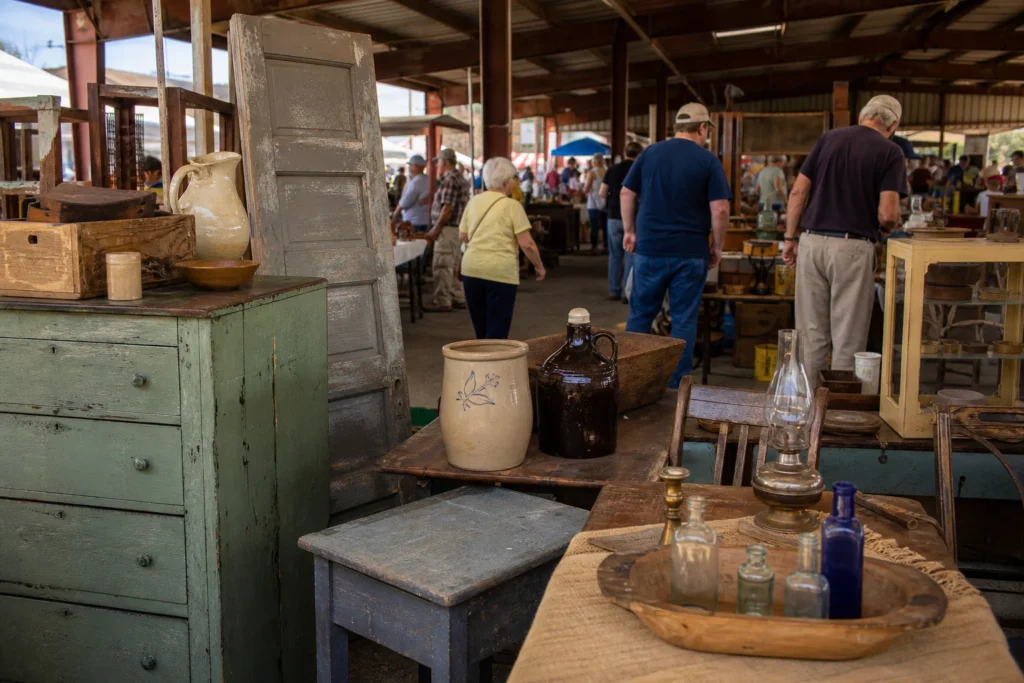
The merchandise spans nearly two centuries of American material culture. Early 19th-century primitives sit a few rows away from mid-century ceramics, 1970s advertising ephemera and pop-art oddities. Furniture, textiles, glassware and decorative objects from a dozen different eras all turn up regularly. The strict no-reproductions rule means that even the browsing feels different — every object you pick up has an actual past behind it, not a factory approximation of one.
More than 125 vendors set up under cover, which keeps the indoor section worth visiting even on a grey or wet morning. The market runs rain or shine regardless, and the layout rewards a full visit. Paved walkways make browsing comfortable across the whole site, rest areas are scattered throughout, and wheelchair-accessible restrooms are available on-site. Food and refreshment stands occupy all four midway corners, so a break is never far away.
The atmosphere leans unhurried. Dealers here tend to be knowledgeable and are generally happy to discuss provenance. Serious collectors tracking a particular period — say, American primitives or mid-century industrial design — find enough depth to make the drive worthwhile. Decorators sourcing period pieces for specific rooms get genuine variety in a single morning. And casual visitors who simply enjoy looking at well-preserved objects with real stories behind them find plenty to hold their attention.
Publications including Midwest Living, Antique Trader, Antique Week, Cincinnati Magazine and Indianapolis Monthly have all featured the market over the years. That breadth of coverage reflects a long-standing reputation, not a single moment of attention. A market that has run consistently for nearly four decades and still draws crowds from three states has clearly done something right.
Lawrenceburg is most practically reached by car. Visitors travelling by long-distance rail can arrive at Cincinnati Union Terminal, served by the Amtrak Cardinal train, approximately 27 km away across the Ohio border — a reasonable option for those combining the market with a Cincinnati stay. The Cincinnati streetcar, tram line 100, serves stops in Cincinnati's Over-the-Rhine and Findlay Market neighbourhoods, but operates within the Cincinnati city network and is not a practical connection to the Lawrenceburg site itself. Most visitors will want a car for the final leg regardless of how they arrive.
Frequently Asked Questions
Q: Is the Tri-State Antique Market strictly antiques, or will I find new and reproduction goods too?
A: Strictly antiques and vintage. Every item must be at least 30 years old and no longer in production — no reproductions, no new goods. That single rule shapes the entire seller mix, so everything you pick up has a genuine history behind it rather than a factory approximation of one.
Q: When does the market run, and what are the hours?
A: The market is held on the first Sunday of each month from May through October, with gates open from 7:00 in the morning until 3:00 in the afternoon. It runs rain or shine, and the more than 125 indoor vendors keep the experience worthwhile even on a grey or wet morning. Confirm dates on the organizer's official page before you make the drive.
Q: What kinds of antiques tend to turn up at the Tri-State?
A: The range covers nearly two centuries of American material culture. Early 19th-century primitives and folk objects sit alongside mid-century furniture, ceramics, advertising ephemera and glassware, with 1970s pop art and later collectibles toward the newer edge of the eligibility window. Serious collectors tracking a specific period and decorators sourcing period pieces both find enough depth to make a full morning worthwhile.
Q: Is the site easy to get around, and are facilities available on-site?
A: The grounds are designed for a comfortable visit. Paved walkways run throughout, rest areas are scattered across the site, and wheelchair-accessible restrooms are available. Food and refreshment stands occupy all four midway corners, so a break is never far away regardless of where you are on the grounds.
Q: How far does the Tri-State Antique Market draw from, and how big is it?
A: The market sits in Lawrenceburg, Indiana, at the point where Indiana, Ohio and Kentucky meet along the Ohio River, which gives it a natural regional pull across three states. More than 200 vendors attend each event, drawing an estimated 3,000 shoppers per date — a scale the market has sustained since it opened in 1986.
Marketplace Highlights










Add a review