

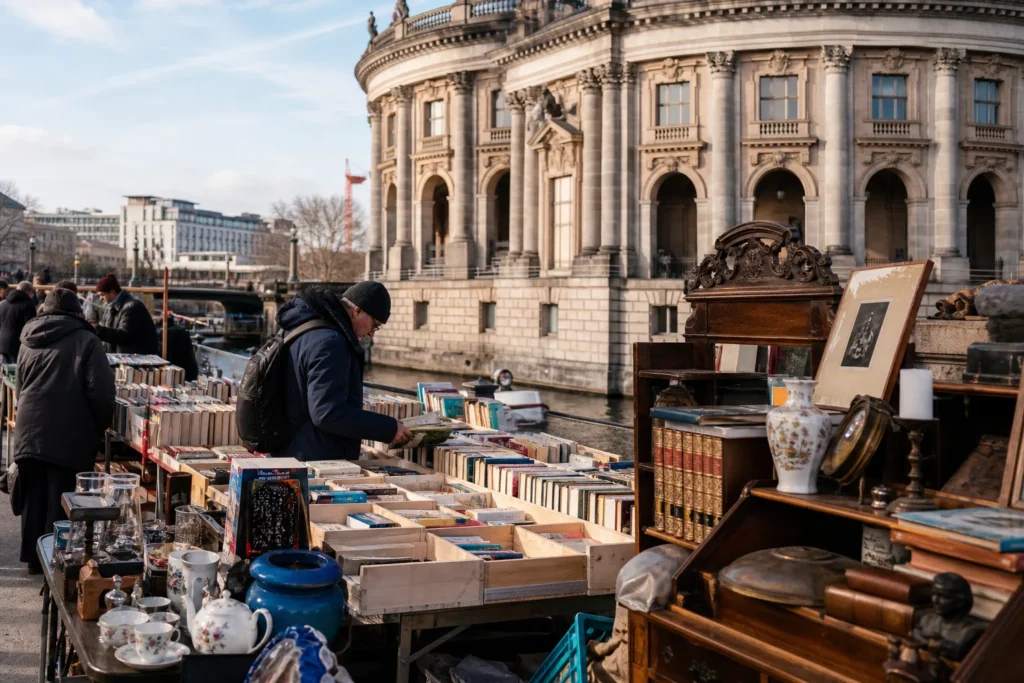

Trestle tables piled deep with books are what stop people first. Art history monographs, dog-eared German paperbacks, old travel guides, technical manuals, vinyl records tucked alongside stamp albums — the Antique and Buchmarkt at Bodemuseum runs on a specific kind of accumulated knowledge. The Buchmarkt dimension genuinely sets it apart from most of Berlin's weekend antique gatherings, where books appear only as an afterthought.
The setting, when you look up from the stalls, is extraordinary. The market occupies the northern tip of Museum Island, with the Spree moving quietly alongside and the Bodemuseum's ornate stone facade rising directly behind the vendors. Museum Island carries UNESCO World Heritage status, and very few European flea markets operate against a backdrop anything like it. The location does not feel staged — the market simply belongs here, part of the neighbourhood's unhurried weekend rhythm.
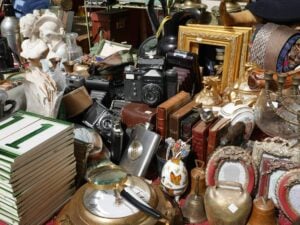
Beyond books, the stalls offer a well-sorted cross-section of European antique material. Decorative tableware draws collectors to porcelain, glassware and silverware. Paper and ephemera enthusiasts tend to slow down the most — vintage photographs, postcards and stamps surface here more reliably than at many of the city's larger markets. Vinyl records, small paintings and coin trays round out the mix. Occasional pieces of furniture appear, but the market's strength is in the smaller, handleable objects.
A handful of stalls lean toward contemporary handcraft rather than antiques, and the makers are usually present in person. That matters: conversations with sellers come easily across the whole market, and bargaining is a natural part of doing business. Picking up a coin, turning over a photograph, asking a vendor where something came from — that tactile, unhurried exchange is the experience the market does best.
Compared with the scale and crowd energy of the Flohmarkt am Mauerpark or Trödelmarkt Arkonaplatz, this is a smaller, quieter event. The quality-to-clutter ratio tends to feel higher as a result, though patient rummaging still turns up surprises. The market opens at 10:00 on Saturdays and Sundays and runs until 17:00, which suits a long morning browse followed by lunch nearby. Focused collectors, bibliophiles and visitors already exploring Museum Island will find the format fits naturally into their day.
The riverside position rewards a slower visit. A morning at the market pairs well with a walk along the Spree or a stop at one of the adjacent museums. That layering — browsing beside the river, a medieval coin in one hand, the Bodemuseum's copper dome overhead — is what makes this market genuinely different from anywhere else in the city.
Getting here by public transport is straightforward. Tram lines 12 and M1 stop at Georgenstraße/Am Kupfergraben, approximately 200 metres away. Tram lines M1 and M5 serve Monbijouplatz at around 300 metres. For S-Bahn connections, Oranienburger Straße links lines S1, S2, S25 and S26 at roughly 350 metres. U-Bahn line U6 runs to Friedrichstraße at approximately 430 metres, useful for visitors arriving from further afield across the city.
Frequently Asked Questions
Q: What makes this market different from other Berlin weekend antique markets?
A: Books are the defining feature. Dealers spread deep, browsable stacks of art history monographs, German paperbacks, old travel guides, technical manuals and paperback oddities across trestle tables — a Buchmarkt dimension that most of Berlin's weekend antique gatherings simply don't have. The setting adds to the difference: the market runs on the northern tip of Museum Island, directly in front of the Bodemuseum's ornate stone facade with the Spree running alongside.
Q: What kinds of antiques and collectibles can shoppers expect to find?
A: Beyond books, the stalls carry porcelain, glassware and silverware, vinyl records, small paintings, coins and occasional furniture. Collectors with an eye for paper ephemera — vintage photographs, stamps and postcards — tend to do particularly well here, as these categories surface more reliably than at many of the city's larger markets.
Q: Is bargaining expected, and can you talk to sellers about what they're selling?
A: Bargaining is a normal part of doing business at the market. Vendor conversations come easily — picking up a coin, turning over a photograph and asking where it came from is exactly the kind of exchange the format encourages. A handful of stalls focus on contemporary handcraft, and those makers are usually present in person to discuss their work.
Q: How big is the market, and what's the best time to visit?
A: This is a smaller, quieter event compared with the Flohmarkt am Mauerpark or Trödelmarkt Arkonaplatz, which suits focused collectors and bibliophiles rather than those seeking a festival atmosphere. The quality-to-clutter ratio tends to feel higher as a result. The market runs Saturdays and Sundays from 10:00 to 17:00, making a long morning browse followed by lunch nearby a natural fit.
Q: How do you get to the market by public transport?
A: Tram lines 12 and M1 stop at Georgenstraße/Am Kupfergraben, roughly 200 metres from the market and the closest option. Friedrichstraße station (U6) is around 430 metres away, and Oranienburger Straße (S1, S2, S25, S26) is approximately 350 metres. All three are straightforward connections from central Berlin.
Marketplace Highlights







Add a review