

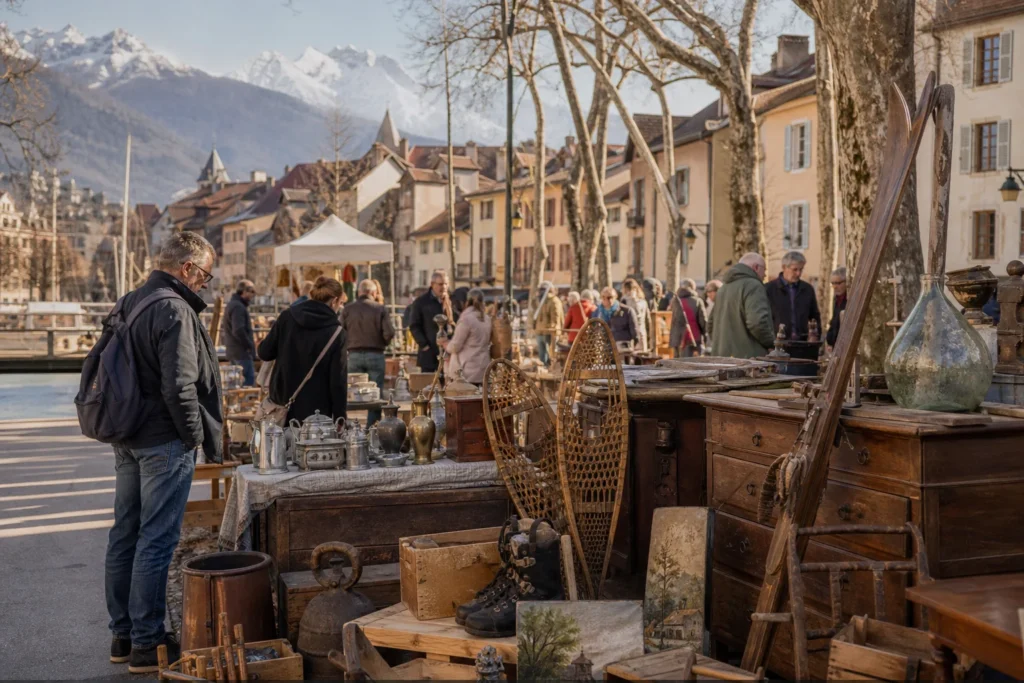

The Annecy Flea Market runs on the last Saturday of every month, opening at 08:00 and running through to 18:00. It fills the streets of the Vieux Quartier alongside the Thiou River with up to 200 professional dealers. Stone bridges arch overhead, canal-side facades reflect in the water, and medieval laneways funnel the crowd between tightly packed stalls. The setting is genuinely remarkable, but collectors come for the stock rather than the scenery.
Alpine antiques give this brocante its identity. Dealers bring vintage ski equipment, wooden snowshoes, antique fishing gear and traditional dairy tools — milk jugs, butter moulds and cheese-making implements from Haute-Savoie farmhouses. Decorative and working cowbells appear in real variety. These objects come from the rural economy of the region, and finding them here, in the town that sits at the foot of the Alps, carries an authenticity that more generic fairs rarely match.
Beyond the alpine material, the market runs a full range of French brocante essentials. Antique paintings, silverware and provincial pottery share tables with decorative linen and ceramic crockery. Period furniture arrives in pieces suited to carrying home or organising a courier. The breadth serves both the collector with a clear target and the browser who wants to wander without a plan.
Local artisans add texture to the experience. Many stallholders produce their own work and welcome a conversation about their craft and materials. A short exchange can deepen appreciation of regional techniques considerably. Visitors often describe this informal dialogue as one of the things that separates Annecy from larger, more anonymous antiques fairs.
The market draws a genuinely international crowd. The proximity of the Swiss and Italian borders means cross-border visitors arrive chasing specific categories — alpine collectables in particular travel well across those frontiers. That steady flow of knowledgeable buyers keeps the dealer offering competitive and ensures fresh stock from month to month.
Arriving at opening gives the clearest advantage. The best alpine pieces and the most interesting decorative finds tend to move early, before the broader tourist crowd arrives later in the morning. The Château d'Annecy sits above the old town, and the lake and surrounding mountains offer an obvious reason to extend the visit beyond market hours.
Getting here by public transport is straightforward. Gare Quai Sud, approximately 400 metres from the market, serves train lines including TGV 518 and several TER services, alongside bus routes 1, 2, 3, 4, 5, 6, 7, 10, 15, 15A and 15B, among others. For a closer local option, the Hôtel de Ville bus stop sits roughly 250 metres away and is served by buses 15A, 15B, 26, 27, S1 and Y51. The Annecy ferry stop also sits approximately 400 metres from the market — a more scenic approach for visitors arriving by lake.
Frequently Asked Questions
Q: When does the Annecy Flea Market take place?
A: The market runs on the last Saturday of every month, from 08:00 to 18:00, in the historic Vieux Quartier along the Thiou River.
Q: What makes this market worth travelling to specifically for alpine antiques?
A: Up to 200 professional dealers bring stock rooted in the rural economy of Haute-Savoie — vintage ski equipment, wooden snowshoes, antique fishing gear, dairy tools such as butter moulds and cheese-making implements, and decorative and working cowbells. These categories appear here in genuine depth and variety that most general brocantes cannot match.
Q: Is there a best time to arrive if you are serious about buying?
A: Arriving at opening, around 08:00, gives the clearest advantage. The most interesting alpine pieces and the stronger decorative finds tend to move before the broader tourist crowd arrives later in the morning.
Q: Can I get to the market easily by public transport?
A: Yes. Gare Quai Sud, roughly 400 metres away, is served by TGV and TER train services as well as multiple bus routes. The Hôtel de Ville bus stop is even closer at approximately 250 metres and is served by several local lines.
Q: Is the market worth visiting if alpine antiques are not my focus?
A: Easily. Alongside the alpine-specific stock, dealers bring antique paintings, silverware and provincial pottery, decorative linen and ceramics, and period furniture in pieces suited to carrying home or shipping. Local artisans also sell their own work and are generally happy to talk about regional craft techniques, which adds a dimension rarely found at larger, more anonymous fairs.
Marketplace Highlights








Add a review