

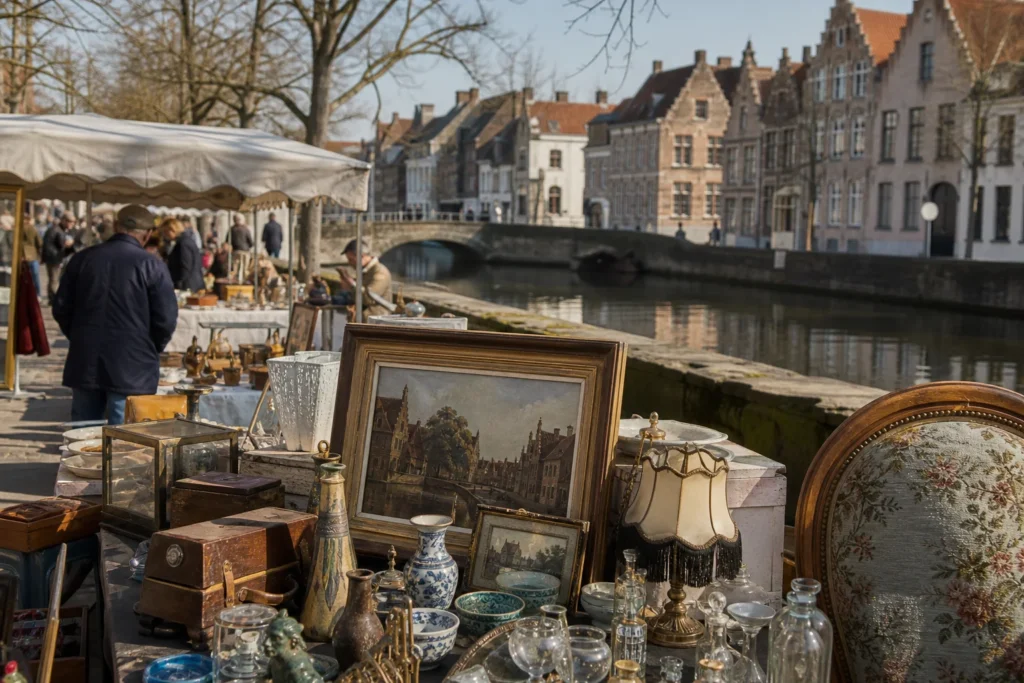

Few weekend markets earn their setting quite as honestly as the Dijver flea market in Bruges. It runs along the Dijver canal bank every Saturday and Sunday from 10:00 to 18:00, from mid-March through mid-November, with Fridays added during the summer months of June to September. The folkloric market designation is what makes it genuinely distinctive — and what separates it from a general car-boot or secondhand fair.
Under Belgian folkloric market rules, every item on sale must be at least fifty years old. That single requirement filters the seller profile and raises the quality floor across every stall. Dealers come here, not casual clearers. The result is a browsable stretch of antiques where almost anything you pick up has genuine age behind it.
The merchandise clusters into several satisfying collector veins. Antique paintings and silverware tend to draw the dedicated specialist. Ceramics, crockery, glassware and figurines attract a second, broader wave of collectors. Vintage books, prints and small decorative objects fill the middle ground. Look out too for worn Flemish country furniture — the kind of substantial, honest piece that suits a canal-house interior perfectly. Vintage clothing rounds out the offer for fashion-minded browsers. Casual visitors find plenty to enjoy; collectors with a specific period or object in mind will find the search genuinely rewarding.
The market spreads across more than just the canal bank. Stalls extend into neighbouring Koning Albertpark and continue toward Beursplein, the square close to Bruges's central railway station. Each zone has its own slightly different mix of dealers and objects, giving the visit a natural drift rather than a single fixed loop. Arriving from the waterside and working gradually toward the square makes for a satisfying two-hour circuit. Most of the old town centre lies within easy walking distance, so the market sits naturally inside a broader morning in Bruges.
Early arrival pays off. The most unusual pieces move quickly in the first hour, and dealers are freshest at the opening. By late morning the crowds build and the best finds are often already gone. Antique prints, silverware and ceramics in particular reward an early start.
For access, the Brugge Dijver (Centrum) bus stop is approximately 83 metres away and served by bus lines 1 and 2. The stop puts the market within easy reach from the wider city. One genuinely atmospheric alternative is to arrive by water: two canal boat landings — Gruuthuse (Nr. 3) and De Meulemeester (Nr. 5) — sit within roughly 75 to 125 metres of the market. Stepping off a canal boat and walking straight into an antiques market is a small pleasure that only a handful of European markets can offer.
Bruges rewards a longer antiques itinerary. The Brugge Zandfeesten is a separate, periodic antique fair with a larger footprint and a different atmosphere — a useful complement for anyone building a regional collecting trip. The Dijver market sits beside it as the city's weekly constant: smaller in scale, strictly curated by its folkloric rules, and set against a backdrop that most market towns would genuinely envy.
Frequently Asked Questions
Q: What is a folkloric market, and why does it matter at Dijver?
A: Under Belgian folkloric market rules, every item for sale must be at least fifty years old. That single requirement keeps the stalls free of the new-goods clutter common at general flea markets and attracts established dealers rather than casual car-booters, raising the quality floor noticeably across every vendor.
Q: When does the Dijver market run, and what are the opening hours?
A: The market runs every Saturday and Sunday from 10:00 to 18:00, from mid-March through mid-November. Fridays are added during June, July, August and September. Check the organizer's official page before planning a visit, as dates can shift.
Q: What is the best time to arrive if you are hunting a specific piece?
A: Arriving at or just after opening gives the clearest advantage. The most unusual pieces — particularly silverware, antique prints and ceramics — move quickly in the first hour, and dealers are freshest at that point. By late morning the crowds thicken and the best finds are often already claimed.
Q: What kinds of antiques and collectibles does the Dijver market typically carry?
A: The stalls cover a broad range within the fifty-year rule: antique paintings and silverware at the specialist end; ceramics, crockery, glassware and figurines for a wider collecting audience; vintage books, prints and small decorative objects in the middle; and worn Flemish country furniture for buyers fitting out a period interior. Vintage clothing also features regularly.
Q: How is the market laid out, and how do you reach it?
A: Stalls run along the Dijver canal bank and extend into Koning Albertpark and toward Beursplein near the central railway station. Bus lines 1 and 2 serve the nearby Brugge Dijver (Centrum) stop. Alternatively, two canal boat landings — Gruuthuse and De Meulemeester — sit within roughly 75 to 125 metres of the market, making an arrival by water a genuine option.
Marketplace Highlights








Add a review